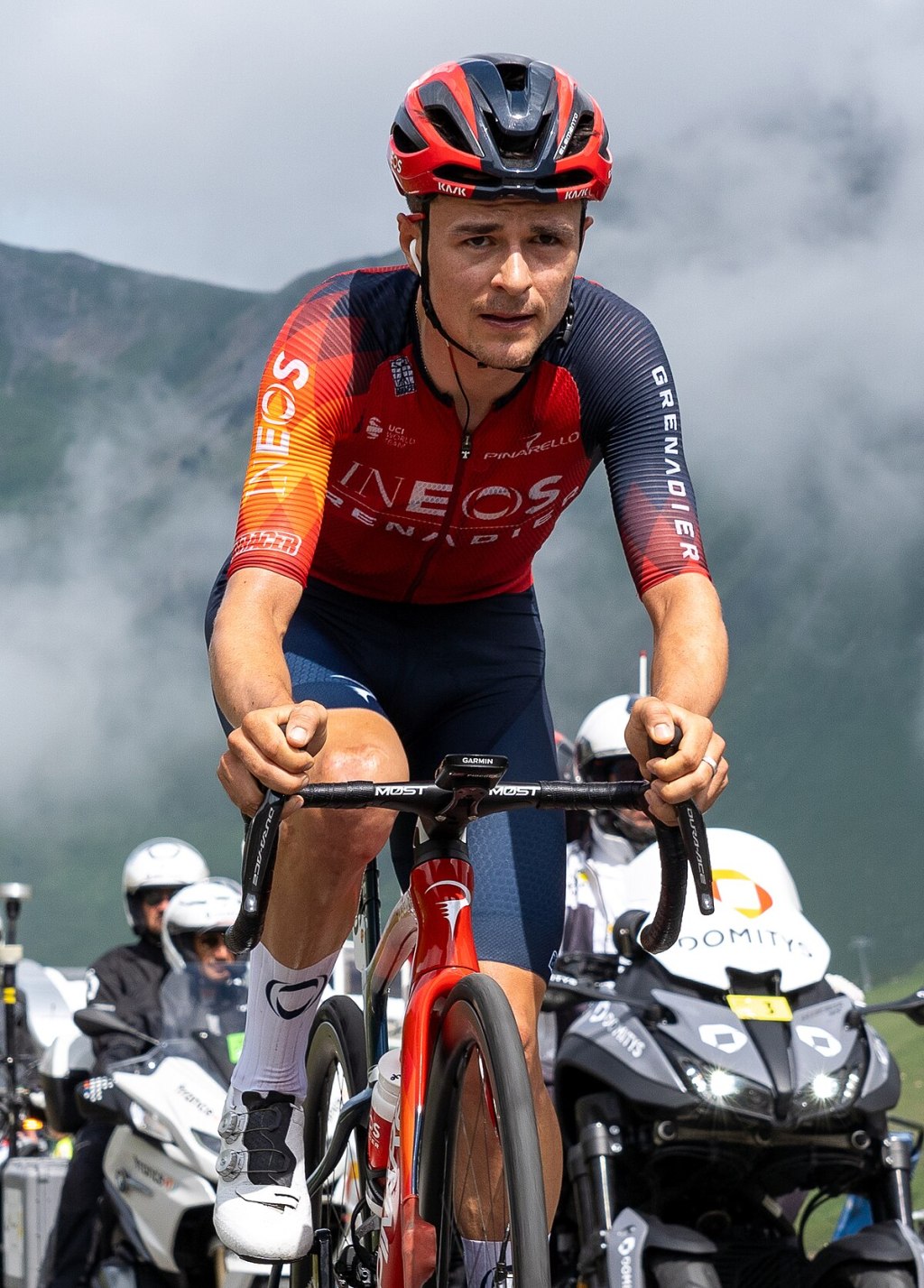
There are an eerie number of parallels between two of the biggest transfers of this cycling off-season. Tom Pidcock and Maxim Van Gils are both just 25 years old. Both riders have ridden four professional seasons and have five victories. They are the exact same type of rider (solid lightweight puncheurs with decent long-climbing abilities but yet unproven GC talent). Both riders signed what we must assume are large contracts (2m Euros/year+) relative to their respective palmares, based in large part on their perceived potential.
On the antagonistic front, Pidcock left a big team, INEOS Grenadiers, to join a smaller one, Q36.5, while Van Gils left a small team, Lotto Dstny to join a rising power, Red Bull – Bora – Hansgrohe. Pidcock regressed from 2023 to 2024, while Van Gils improved significantly. But Pidcock’s career resume is far superior to Van Gils’, as the Yorkshire man has won Amstel Gold Race, a stage of the Tour de France, and Strade Bianche, while Van Gils has yet to get a single victory on par with those races.
Because of their incredible similarities and the fact that they switched teams for the first time in each of their careers within the span of a week this off-season, I thought it would be a fun thought experiment to debate which rider one would rather have in his squad for the rest of his career. The conventional wisdom, over the course of the last year or two, has swung heavily in favor of Van Gils. I fear there is an enormous amount of recency bias leading fans to that conclusion. But let’s examine the pros and cons of each rider and how they might fit into their new teams.
Thomas Pidcock was a prodigy from his days as a junior and U23 rider, with a signature accomplishment being his evisceration of the 2020 “Baby Giro” while riding for Trinity Racing. INEOS then snapped him up for 2021 as one would expect of the biggest British talents in years, and he has ridden for the rich, Manchester-based squad since then.
Fair or not, the expectations have thus always been sky-high for Pidcock, and frankly, he has failed to deliver on his promise. Not once in his four-year career has he defeated the best riders in the world in a fair-and-square, head-to-head match-up. His victories in Strade, Amstel, and a stage of the 2022 Tour unfortunately all have asterisks because either most or all of the Big Six were not present, or he snuck away in a breakaway (as on Alpe d’Huez in the 2022 Tour de France).
That’s not to say he has not had success in the WorldTour peloton. Since turning pro, he has finished 58th, 58th, 23rd, and 30th in the ProCyclingStats.com year-end ranking. He also finished second in Liege-Bastogne-Liege in 2023 and second in Amstel in 2021, among other solid results. And frankly, I believe the hype he generated as a young buck was largely unwarranted. Where and when has he ever shown the ability to climb or sprint, let alone time trial, with the better riders like Mathieu van der Poel, Tadej Pogacar, and Jonas Vingegaard?
This brings me to the likely reason he was overhyped: his versatility. Pidcock now has a world title in cyclocross and two Olympic Gold Medals in Mountain Bike under his belt. That would be a great career in itself already, but it is also a curse. Because as a junior, he was one of the best roadies in addition to being a top MTB and CX rider. The thinking that if such a lightweight rider (58kg) can perform on the MTB and CX courses, when he focuses on the road, he will rocket up long Alpine climbs. In reality, there are simply more talented climbers that target the Grand Tours and other stage races, and Pidcock’s has likely harmed his road career by getting distracted with these other disciplines.
So what can we expect going forward from the young journeyman? Well, I probably am far more bullish than most commentators on Pidcock. I think he has every chance to resurrect his career and become a top-1o rider in the world. Will he win the Tour de France or multiple Monuments? It’s highly doubtful. But he can be a consistent performer who wins Grand Tour stages, Classics, and may sneak a Monument eventually. My main concern is that Q36.5 might not be the best support system for him, not to mention that they do not get invited to every big race as a non-WorldTour team. But Pidcock’s star power could change that to an extent, and they might find themselves in the WorldTour in a few years if they score enough points.
Despite lacking a single big win so far, Maxim Van Gils has progressed nicely from the 365th ranked rider in 2021 to the 22nd in 2024. And at the beginning of this season, he was sitting as high as seventh. That, of course, means he faded during most of the final two-thirds of 2024. If anything, though, this means that his top level is high enough to do serious damage in all but the biggest races.
In the future, Van Gils should continue to progress. He’s joined a high-budget, cutting-edge operation in RBBH. He won’t have to carry the points-scoring load for a small team looking to get promoted back to the WorldTour (which is partly what he was doing at Lotto). He can target races that suit him perfectly (such as Strade and the Ardennes) and likely have access to better support and training. It is rumored that he will not even ride a Grand Tour next year as Red Bull’s squad is too stacked to include him as anything but a middling domestique. This can be a great scenario for him.
So what’s the verdict?
In my view, this is essentially a toss-up with the tie-breaking factor being the respective team setups each rider has chosen. RBBH is simply going to be light-years ahead of Q36.5 in every regard, and because of that, I would rather be in Van Gils’ shoes at this very moment.
The moral of the story is that money dictates everything (Red Bull’s budget is probably at least triple Q36.5’s).
On that note, I’ll be back soon.
Jamie
 Puncheur
Leave a comment